Tooling & Die Design: The Foundation of Precision Metal Manufacturing
Introduction
In metal stamping manufacturing, tooling is a fundamental element that directly affects dimensional accuracy, repeatability, and production stability.
A well-designed die ensures that parts are consistently produced within specified tolerances while maintaining efficient and reliable production processes.
Why Tooling Quality Matters
The ability to produce parts within defined tolerances over continuous production cycles depends on tooling quality.
Well-designed tooling supports:
- Consistent dimensional accuracy
- Stable part quality
- Reduced production variation
- Controlled process behavior
This ensures predictable and repeatable manufacturing results.
What Is a Progressive Die?
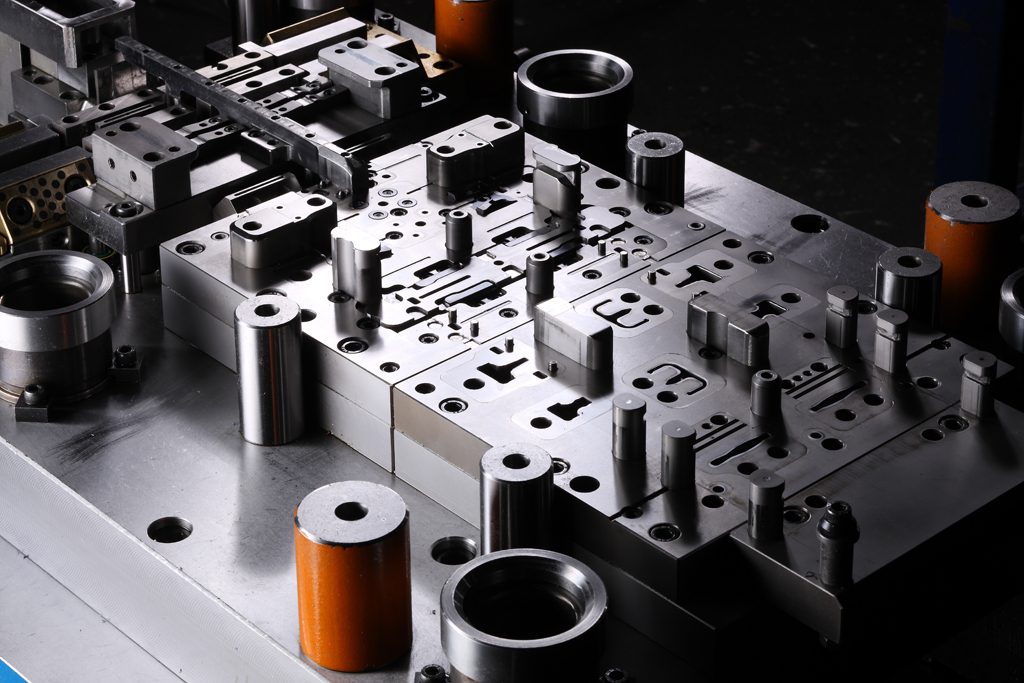
A progressive die is a tooling system where multiple operations are performed within a single tool through sequential stations.
Typical operations include:
- Cutting
- Piercing
- Forming
- Bending
- Tapping
This structure enables continuous production flow while maintaining part consistency.
Advantages of Progressive Die Systems
Progressive dies provide several advantages in high-volume production:
- Reduced production time
- Improved efficiency
- Lower labor dependency
- Optimized material usage
- Consistent part quality
These benefits make progressive dies suitable for scalable manufacturing environments.
Tool Maintenance and Production Stability
Regular tool maintenance is essential to sustain production quality.
It helps to:
- Extend tool life
- Maintain dimensional accuracy
- Prevent unexpected failures
- Support continuous production
Preventive maintenance plays a key role in minimizing downtime.
Tool Design in High-Volume Production
In high-volume manufacturing, tooling must be designed not only for geometry but also for operational efficiency.
Key considerations include:
- Minimizing downtime
- Reducing maintenance frequency
- Supporting stable high-speed production (SPM)
A well-engineered tool contributes to both productivity and consistency.
Factors Affecting Tool Life
Tool lifespan is influenced by multiple factors:
- Tool design
- Material selection (tool steels, guide components, bushings)
- Preventive maintenance
- Press capacity
- Stroke rate (SPM)
Managing these parameters effectively ensures long-term tool performance.
Material Considerations in Tooling
Different materials require different tooling strategies.
Material properties affect:
- Tolerance requirements
- Wear resistance
- Tool life
- Process stability
Adapting tooling design to material characteristics is essential for consistent production.
Conclusion
Tooling is the backbone of precision manufacturing.
A structured approach to die design and maintenance supports consistent product quality, efficient production, and long-term operational stability.
🔗 Explore More
This topic is part of our integrated manufacturing capabilities.