Automation in Manufacturing: Stability, Efficiency and Process Control
Introduction
Automation plays a key role in modern manufacturing by enabling stable, measurable, and repeatable production processes.
It supports quality consistency, improves efficiency, and provides traceability across all production stages.
Impact of Automation on Product Quality
Automation contributes to product quality by stabilizing production conditions.
Key benefits include:
- Consistent process control
- Stable product characteristics
- Reduced variation in production
- Systematic separation of defective parts
By reducing dependency on manual intervention, automation helps maintain consistent output quality.
Semi-Automatic vs Fully Automated Production
The level of automation depends on product structure and production strategy.
Fully Automated Systems
Suitable for:
- Standardized products
- High-volume production
- Low product variation
Advantages:
- High efficiency
- Lower unit cost
- Consistent quality
Semi-Automatic Systems
Preferred when:
- Product variety is high
- Frequent adjustments are required
- Production volumes are flexible
Advantages:
- Faster adaptation
- Reduced setup time
- Optimized investment efficiency
Semi-automation is also effective during early production phases.
Reducing Error Rates Through Automation
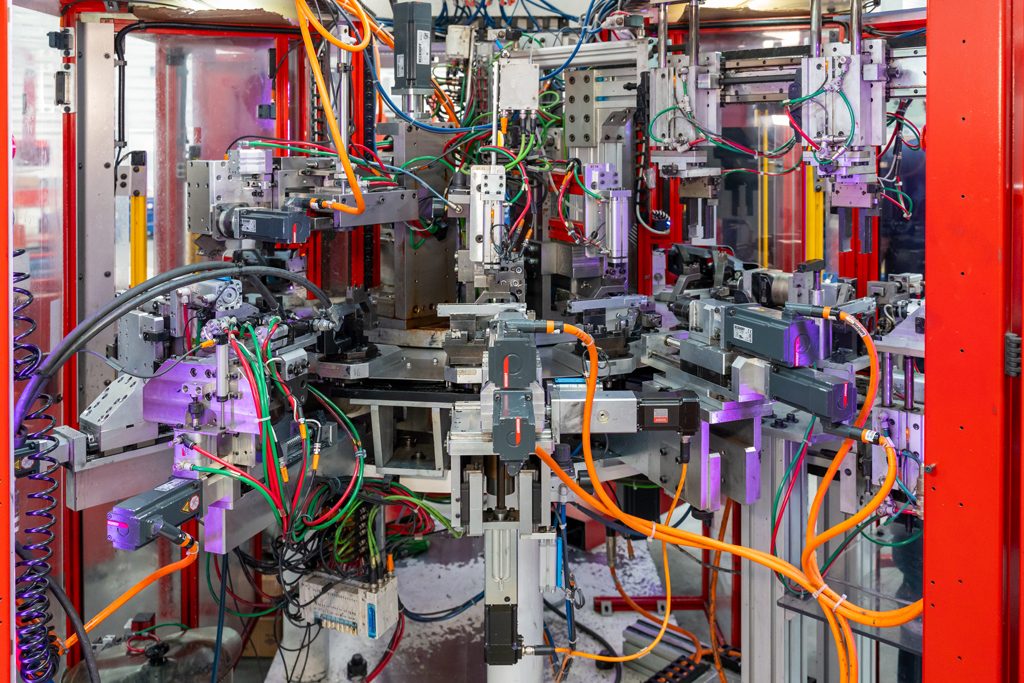
Automation systems enable real-time monitoring and early detection of process deviations.
Examples include:
- Measurement of spring forces and process data analysis
- Camera systems detecting visual defects
- Load cells and sensors identifying incorrect assembly
- Digital controls enabling rapid parameter adjustments
These systems help prevent errors from progressing through the production line.
Advantages in Small Part Manufacturing
Automation is particularly beneficial for small and sensitive components such as springs, pins, and rivets.
It enables:
- Continuous and precise feeding
- Accurate positioning
- Increased production speed
- Reduced dependency on operator skill
This improves overall production performance.
Operator and Machine Collaboration
Automation systems work most effectively when combined with skilled operators.
Efficiency depends on:
- Operator knowledge of the system
- Fast response to process issues
- Effective maintenance support
- Optimization of cycle times
Stable material feeding also supports consistent production flow.
Key Considerations for Automation Investment
Successful automation requires careful planning.
Important factors include:
- Compatibility with product requirements
- Ease of maintenance and accessibility
- Suitable cycle time for production targets
- Flexible and user-friendly system design
- Availability of critical components
A well-designed system supports both efficiency and long-term sustainability.
Conclusion
Automation is essential for building stable and efficient manufacturing systems.
It improves process control, reduces variability, and supports consistent production performance.
🔗 Explore More
This topic is part of our integrated manufacturing capabilities.